How Optical Illusions Actually Work
Your brain is an incredible prediction machine. It doesn’t just see the world — it constantly fills in gaps using past experience. Optical illusions exploit these shortcuts, creating moments where “what you see” and “what is really there” don’t match.
Types of Optical Illusions
- Physical illusions – tricks caused by the physics of light and how our eyes work (refraction, afterimages)
- Physiological illusions – caused by overstimulation of the eyes and brain neurons
- Cognitive illusions – the most mind-bending: your knowledge and expectations betray you
- Ambiguous illusions – images that have two (or more) equally valid interpretations
Classic Examples Comparison
| Illusion | Type | What Your Brain Does | Try It Yourself |
|---|---|---|---|
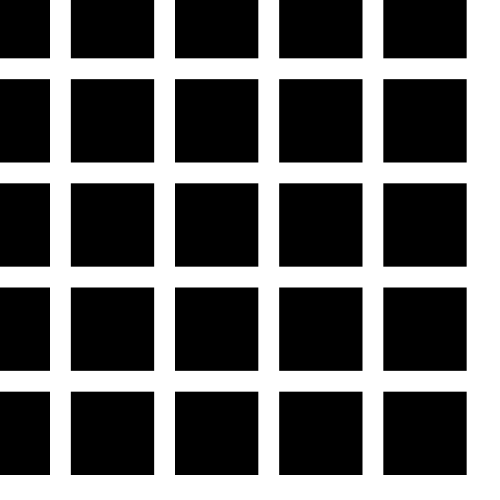
| Hermann Grid | Physiological | Lateral inhibition creates gray dots at intersections that aren’t really there | Stare at one square — the dots disappear |
| Rotating Snakes | Cognitive + Physiological | Peripheral vision + high contrast fools motion detectors | Look directly at one “snake” — it instantly stops |
| Ponzo Illusion | Cognitive | Brain uses perspective cues to misjudge size | The two bars are exactly the same length |
| Café Wall Illusion | Physiological | Tile + mortar contrast makes straight lines look slanted | Measure with a ruler — they’re perfectly parallel |
Instructions to Test Your Vision
- Find a comfortable sitting position about 50cm from the screen.
- Focus your eyes on the center of the illusion for at least 20 seconds.
- Look away to a plain white wall or a static object nearby.
- Observe the residual motion or color shifts in your perception.
These illusions aren’t just party tricks — they reveal how our perception is actively constructed by the brain. Ready to see more?